Interview Aleksey Lidov
Is this your first time here on Tenerife?
Yes, this is my very first time. And I did not plan any trip to Tenerife before, so without Wanja’s suggestion and, I would say, nice pressure, I would not have come here. But I am happy that it happened.
Вы первый раз на Тенерифе?
Да, первый раз. Я не планировал какой-либо поездки на Тенерифе раньше, так что, если бы Ваня не был так настойчив, я бы не приехал. Но очень доволен, что это произошло.
Do you travel a lot because of your profession?
Yes, I travel a lot because I am an art historian. Recently I’ve been working a lot with a special subject of art and culture, with a project related to the making of sacred spaces, which I consider a special form of human creativity and a part of the artistic culture. But, originally, my research field is Byzantine and medieval art in general. Only recently I became interested in the latest tendencies of contemporary art — especially, in multimedia installations, landscape performances and things like this, not at all in traditional pictures.
Вы много путешествуете из-за Вашей профессии?
Да, я много путешествую, поскольку это часть работы искусствоведа. Последнее время я много занимаюсь особым сюжетом искусства и культуры, а именно созданием сакральных пространств, которое я рассматриваю как особую форму творчества и часть художественной культуры. Однако первоначальная область моих исследований византийское и шире все средневековое искусство. Лишь совсем недавно я заинтересовался новейшими тенденциями современного искусства – особенно, мультимедийными инсталляциями, перформансами и подобными вещами, сосем не традиционными картинами.
And here on Tenerife you have got to know the international cultural project “Mariposa”, What kind of information did you have about it before you came?
To be honest, almost nothing. Unfortunately, it is not too famous in Russia. May be, some people who are doing specifically contemporary art know about it but I did not ask them. I have some very good friends among the leading Russian art critics, may be, they know about it. But for me it was a discovery and the first person who talked to me about was Wanja. He described it briefly to me in Moscow and I became interested in it. Yet, when I came here I found it even more interesting than I expected. I believe that it is an outstanding piece of contemporary culture. And I may congratulate people who actually initiated and created this project. First of all, as far as I know Mr. Hans-Jurgen Muller and his wife Helga Muller and collaborators. In my point of view they did something absolutely outstanding
И здесь на Тенерифе Вы познакомились с международным культурным проектом «Марипоса». Что Вы об этом знали до приезда?
Честно говоря, почти ничего. К сожалению, он не слишком известен в России. Возможно, кто-то из специально занимающихся современным искусством, знает об этом проекте, но я их не спрашивал. У меня несколько близких друзей среди ведущих российских художественных критиков, может быть, они знают. Но для меня это было открытие и первым, кто рассказал мне об этом, был Ваня. Он кратко описал мне Марипосу в Москве и это меня заинтересовало. Однако, по приезде я нашел этот проект еще более интересным, чем я ожидал. На мой взгляд, это выдающееся произведение современной культуры. И я могу только поздравить тех, кто инициировал и осуществил этот проект. Прежде всего, насколько я знаю, Ханса Юргена Мюллера и его жену Хельгу Мюллер, а также их соратников. На мой взгляд, они создали нечто выдающееся.
Wanja presented the project in Moscow to the deputy director of the Museum of Fine Arts, who suggested you to get in contact with him. Do you think this happened by chance or do you think there is a link to your theory of hierotopy and the sacred spaces?
Zinaida Bonami is an old friend and colleague of mine and she is a deputy director of foreign affaires in the Museum of Fine Arts in Moscow. She knew very well about my new project and she had attended some of my lectures recently. Also she knows that I am a specialist in icons, and probably, she realized when she saw Wanja’s pictures that it can be related to the field of my interest. Though I would like to emphasize that I am not writing about contemporary art. I mean concretely, specifically. I am writing about the theories and the tendencies and things like this, but I am not an art critic, but mostly art historian and theorist.
Ваня рассказал о проекте в Москве замдиректора Музея изобразительных искусств, которая посоветовала ему встретиться с Вами. Вы думаете , это произошло случайно, или было как то связано с Вашей теорией иеротопии и сакральных пространств?
Зинаида Бонами – моя давняя знакомая и коллега, сейчас она замдиректора по международным связям в Музее изобразительных искусств в Москве. Она очень хорошо знала о моем новом проекте, она присутствовала на некоторых из моих лекций недавно. Также она знает, что я специалист по иконам, и вероятно, когда она увидела Ванины работы, у нее возникла идея, что они могут меня заинтересовать. Я хотел бы подчеркнуть, что я не пишу о современном искусстве, имея в виду творчество конкретных художников. Скорее пишу о теориях и тенденциях и подобных вещах, но я не художественный критик, больше историк искусства и теоретик.
So you do see a link between your concept about creating sacred spaces, the concept which is being developed in Mariposa and Wanjaґs Artwork there?
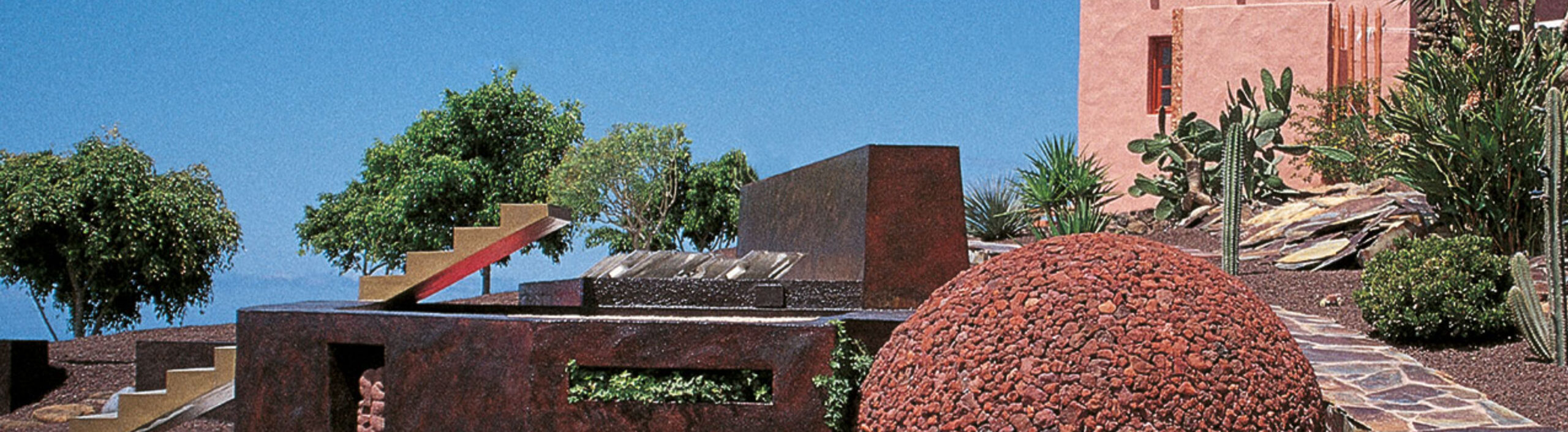
In principle, yes. I think that Mariposa or at least some projects in Mariposa are very much related to the concept of Hierotopy. What is actually the House of Silence in Mariposa? In my point of view it is an attempt to create a new sacred space. Not a traditional one, not one belonging to any of the existent religions like Christianity, Islam or Buddism but at the same time a specific sacred space for contemplation, for thinking about God and transcendental values. And it is characteristic that they invited Wanja to do an Icon inside this house, in his very unusual style and unusual interpretation of the subject, but of course he participated in this creation of a particular sacred space. I also enjoyed very much the idea to make nearby the House of Silence, as a kind of installation, the table under the baldochin, under the roof, with a splendid view to this fantastic landscape of Tenerife, which was included and which contains itself some sacred values in this context. It is the landscape which has been there for millions of years, that becomes sacred through this interpretation of the artist. through the inclusion of this enormous panoramic view, actually created by God for religious people, into this particular space, artistic and sacred space of Mariposa. And the table, also quite symbolic, it is a table for a common meal or a common talk, as a kind of sacred banquet, also included in this environment. So I enjoyed it very much and I think that it works. And even I also enjoyed a lot that they did not make any stylization or imitation of something, that it is quite simple but at the same time it works. It has the esthetical and spiritual background and the sacred values, because in that space you immediately feel that there is something sacred in the world. The artists who planned this environment, who invented this architecture and painted this icon, they certainly revealed the sacred values which exist in the world, so it is Hierotopy, it is an artistic creativity in the creation of sacred spaces.
То есть вы видите связь между вашим понятием создания сакральных пространств и концепцией, представленной на Марипосе и Ваниной работой?
В общем, да. Я думаю, что Марипоса или, по крайней мере, некоторые проекты здесь представленные непосредственно связаны с понятием иеротопия. Что такое на самом деле Дом тишины на Марипосе? Мне кажется, это попыптка создать новое сакральное пространство. Не традиционное, принадлежащее к какой-либо религии — христианству, исламу или буддизму, но в то же время определенное сакральное пространство для созерцания, размышления о Боге и сверхъестественном. Примечательно то, что они предложили Ване сделать икону внутри этого дома, в его необычным стиле и с необычной трактовкой сюжета, и он, конечно же, принял участие в создании этого особого сакрального пространства. Мне также очень понравилась идея сделать рядом с домом инсталляцию в виде столика под балдахином, под крышей, с великолепным видом на сказочный пейзаж Тенерифе, который является частью инсталляции и в данном контексте становится иконическим сакральным образом. Этот пейзаж, просуществовавший миллионы лет, становится сакральным через интерпретацию художника, который включает часть природы, созданную Богом по мысли религиозных людей, в определенное пространство — художественное и сакральное пространство Марипосы. Стол тожевоспринимается как символический предмет. Возможно, это стол для совместной трапезы и беседы, своего рода священного пира, который тоже включен в окружающую среду. Мне это очень понравилось, и я думаю, это работает. В то же время, я рад, что они не сделали стилизацию или подражание чему-то. Все это сделано достаточно просто, но вместе с тем достигает цели. Здесь есть эстетическая и духовная основа, и качества сакрального, так как в этом пространстве вы сразу же чувствуете, что в мире есть что-то выходящее за границы обыденного. Художники, спланировавшие это, придумавшие архитектуру и икону, безусловно, акцетировали сакральные смыслы, присущие миру, а это и есть иеротопия — художественное творчество, воплощающееся в создании сакральных пространств.
Do you think this could be the very beginning of the creation of a new kind of culture? That through art and sacred spaces we are able to fuse, to get different cultures together and create a kind of a new one?
Well, from an artistic point of view it is a very promising way. I do not speak about religions, for example, for myself I am quite happy with Christianity in its Russian Orthodox form, I believe that this tradition is profound, complex, interesting and more than enough for a proper spiritual life. So, sometimes we should work with this as a sort of inspiration but there are a lot of sides. Besides a purely religious point of view, there is another one. Talking with other contemporary artists I suggested an idea: there is a room in contemporary culture which is not covered by traditional religions or any non traditional sect, but this room can be covered by artists: the specific room of sacredness. Most of contemporary artists are trying to avoid this sacredness and even are afraid of sacredness, some artists told me that it is very dangerous for the art. I do not think so, I think that it is a mistake and an illusion. The art actually is able to make sacred spaces which can be quite useful, interesting and inspiring for common people and not necessarily for the people who belong to any traditional religion. It is just one more option to reveal sacred values and to do so, what is more important, without stylization or imitation, without making, I would say, religious fakes. To make something with nature and from the imagination.
То есть вы видите связь между вашим понятием создания сакральных пространств и концепцией, представленной на Марипосе и Ваниной работой?
С художественной точки зрения это может быть многообещающим. Я не говорю о религиях. Я, например, нахожу христианство в форме русского православия самодостаточным, эта традиция достаточно сложна и интересна сама по себе. Поэтому она вполне может вдохновлять нас, но здесь есть разные аспекты. Кроме чисто религиозного взгляда на это, есть еще и другой. При разговоре с современными художниками я высказал идею о том, что в современной культуре существует ниша, не заполненная ни традиционными религиями, ни нетрадиционными сектами, но которая может быть заполнена художниками: ниша сакральности. Большинство современных художников стараются избегать этой сакральности и даже боятся ее, некоторые из них говорят, что она опасна для искусства. Но я так не думаю, я думаю, это ошибка и заблуждение. А искусство способно создавать сакральные пространства, которые могут быть полезны, интересны, могут вдохновлять людей, совсем не обязательно принадлежащих к традиционной религии. Это еще один из способов выявлять сакральные качества и делать это, что немаловажно, без стилизации и подражания, без создания, я бы сказал, религиозных подделок. Творить вместе с природой, используя воображение.
Maybe it is like giving an expression of the sacred and spiritual which each human being has but is not directly related to any specific religion?
Yes, I am emphasizing, I do not see any contradiction between this approach and any traditional behavior and, I even can imagine, that somebody can declare him or herself as an atheist, it does not matter, if he is able to reveal the sacred values of the world, something spiritual and transcendental, it is fine. This can be very interesting and inspiring for common people, because from my point of view they actually need this inspiration, they need to discuss something seriously and the discussion of many things in the framework of traditional religion sometimes does not help them. The field where there is a combination and fusion of the artistic and the sacred is a especially promising way. But I am emphasizing again, not on the way of stylization of something. I like that I have not seen this stylization in the most of the projects in Mariposa. I could see an attempt to reveal something, to say something seriously. For example in the installation “The seven days of creation”, though somebody may enjoy it or somebody may find it to decorative or too simplistic, it is not a stylization of Christian Iconography or any established European biblical tradition, it is an attempt to recreate and present a new image of the cosmos, but a cosmos created by God, this is also very important, it is not just a decoration, it is an attempt to create a kind of an icon, a spatial icon, not depicted as a flat picture, but an icon presented in space, like a realm of meditation, a realm in which a person could be in contact with the transcendental world. This is very important and in some projects in Mariposa this category, this characteristic is revealed brilliantly and also on the highest esthetical level. All the environment in Mariposa is very beautiful, but we know a lot of beautiful environments but in Mariposa I like that it also has become sacred in a way. Actually what I am very interested in is to find the same kind of quality, that I see in Byzantine art, in contemporary art as well. In Byzantine art, for example, there is no separation between beauty and sacredness, they are existing together, as a single whole, it is not possible to say this is beautiful and this is sacred. Any suggestion that there is a contradiction between beautiful and sacred in this tradition looks absurd. We should think about this, and it is a challenge in a way for contemporary artists.
То есть давать выражение сакральному и духовному, которое есть в каждом человеке, но которое напрямую не связано с какой-либо определенной религией?
Да, я подчеркиваю, что не вижу никакого противоречия между таким подходом и традиционной культурой. Я даже допускаю, что кто-то может заявить, что он атеист, но это не имеет значения, если он способен выявить сакральные качества в мире, что-то духовное и трансцендентное. А это может заинтересовать и увлечь многих людей, так как по-моему, они нуждаются в этом стимуле, в серьезном обсуждении чего-то важного, а традиционная религия иногда им не помогает. Поэтому мне кажется особенно многообещающими попытки сочетания и слиянии я художественного и сакрального. Но еще раз подчеркну, без какой-либо стилизации. Мне приятно , что в Марипосе я не видел такой стилизации в большинстве проектов. Я видел попыптку выявить что-то, сказать что-то серьезное. К примеру, исталляция «Семь дней творения», которая может нравится, а может показаться кому-то декоративной или упрощенной, но это не стилизация христианской иконографии или какой-либо известной европейской библейской традиции, это попытка воссоздать и изобразить новый образ вселенной — вселенной, созданной Богом, это не декорация, это попытка создать нечто вроде иконы, особой иконы, не изображенной как плоская картина, но иконы, представленной в пространстве, как место для размышления, место, где человек может соприкоснуться со сверхъестественным. Это важно и в некоторых проектах на Марипосе эта категория блестяще выявлена и представлена на высочайшем эстетическом уровне. Здесь все вокруг очень красиво, но есть много и других красивых мест, а в Марипосе мне нравится то, что эта красота стала в каком-то смысле сакральной. Мне было бы очень интересно увидеть в современном искусстве то качество, которое было в искусстве Византии. Это отсутствие разделения на прекрасгное и сакральное, они сосуществуют вместе как одно целое и невозможно сказать, это красивое, а это сакральное. Всякое предположение о том, что между красотой и сакральностью есть противоречие — абсурдно. Над этим стоит задуматься, и это своего рода вызов современным художникам.
You and Wanja are thinking of bringing some contemporary artists from Moscow to Mariposa to celebrate a “Mariposium” working with these concepts?
Well, it is just an idea that it would be very good and stimulating for the environment here on Tenerife and for the contemporary artists. We should work on it properly and find an institution which will carry this project but the idea in my point of view is the most important thing, it is the beginning of everything, like a seed, from there we will see how it is going to develop in the future. Anyway we will move in this direction. I think we will succeed or at least achieve some results. I believe Tenerife, specially because of these amazing and extraordinary landscapes as well as this strange atmosphere and realm of legends around the island to be from Atlantis, in a tradition of a sacred volcanic island, makes it very interesting and able to create a stimulating environment and a cultural medium (milieu) for the development of a new project in Hierotopн and the making of sacred spaces.
Планируете ли вы с Ваней привезти современных художников из Москвы на Марипосу, чтобы отметить «Марипосиум» где бы работали ваши идеи?
Пока это только замысел, но он может стать хорошим стимулом как для художников, так и для художественной жизни здесь на Тенерифе. Над этим нужно серьезно поработать, найти организацию, которая займется этим проектом. Но идея — это самое главное, это начало всего, она как зерно и мы увидем, как она будет развиваться в будущем. Во всяком случае мы будем двигаться в этом направлении. Я думаю, нам это удастся, или по крайне мере это принесет какие-то результы. Тенерифе со своими удивительными и необычными пейзажами, а так же странной атмосферой и легендами о происхождении острова из остатков Атлантиды, этот по традиции священный вулканический остров очень интересный и способный создать вдохновляющую обстановку и культурную среду для развития нового проекта по иеротопиии и созданию сакральных пространств.
And at last I would like to ask you, as you are a newcomer to Mariposa and obviously it has made an overall positive impact on you, what did you not like so much about it?
Well, as you have already said I liked it very much and I am not ready to criticize, but may be one critical note can be mentioned. All together Mariposa looks too sweet, I would say it looks too harmonious and beautiful. It seems, contemporary art should also disturb, specially when we are talking about sacred things. May be, in this respect Mariposa looks too esthetical in a way. May be, some introduction of rough reality, conflicts and the problematic of this world would be an interesting addition. But generally, I repeat, that I like it very much. On the other hand the absence of something uncomfortable creates another trouble, because contemporary art, it works like this, should surprise, should be in a way a shock, for ordinary people, because contemporary people are given so much from the TV and from various other sources of information, while at the same time they are quite weakly developed inside in comparison with people who lived before, who used to read a lot and to be trained spiritually and go regularly to the church and things like this. So on the one hand they have a lot of various information about everything, on the other hand they lack spiritual training and inner development, this is a main problem of contemporary people in my view. So in this situation the contemporary art should shock in a way, should actually disturb and should be demanding and not just beautiful. It is again not a contradiction, but Mariposa now looks like an esthetical reservation and this is very nice and very well done and I like it, but if you would like a bit of criticism I would suggest to make something more radical.
И наконец, я хотел бы спросить вас, т.к. вы на Марипосе впервые и ,очевидно, что в целом она произвела на вас положительное впечатление, что вам не очень понравилось?
Как вы только что сказали, мне все очень понравилось и я не готов критиковать, но все же одно замечание выскажу. Все выглядит слишком мило, слишком гармонично и привлекательно. Но по-моему, современное искусство должно тревожить, особенно, когда мы говорим о сакральном. Может, Марипоса в этом отношении выглядит слишком эстетской. Возможно, интересным дополнением бы было присутствие конфликтных сюжетов, жесткой реальности. Но в общем, повторяюсь, мне очень нравится. Но отсутствие чего-либо бесспокоящего создает другую проблему. Ведь современное искусство должно удивлять, шокировать, т.к. современный человек получает большой объем информации из телевизора и других источников, при этом внутренне он достаточно слабо развит по сравнению с людьми жившими раньше, которые много читали, были духовно подготовлены, регулярно ходили в церковь и т.п. Современный человек с одной стороны владеет разнообразной информацией обо всем, с другой — ему не хватает духовной основательности и развития, в этом проблема современных людей, как мне кажется. Поэтому в такой ситуации современное искусство должно шокировать, тревожить, должно быть требовательным, а не только приятным. Опять же это не противоречие, но Марипоса выглядит сейчас как эстетический заповедник, и это прекрасно, но если вы хотите немного критики, то я бы предложил нечто более радикальное.
Thank you very much for giving us the honor of an interview and for putting these ideas into words.
The pleasure is all mine.
Спасибо вам большое за интервью и за изложение ваших идей.
Спасибо, с удовольствием ответил на Ваши вопросы